Portuguese
 korean
 Russian
 Japanese
 Arab
Arab Vietnam
 Italian
 Español
 Turkish
 French
 Deutsch
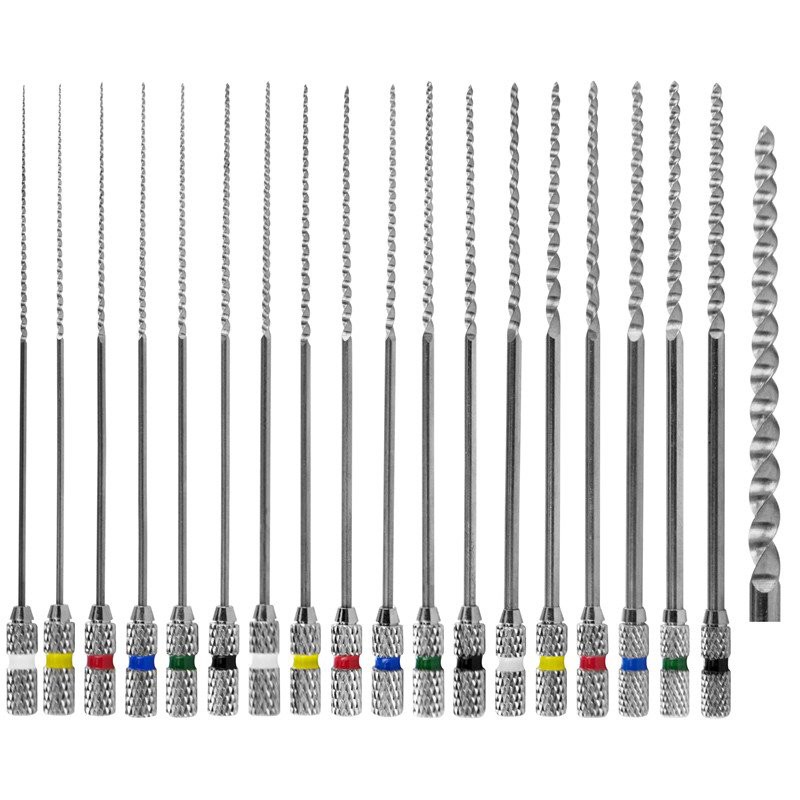
In 1988, Walia et al. produced the first hand-use nickel-titanium root canal files (15#) with orthodontic wires. Compared with similar stainless steel instruments, these files have 2~3 times the bending and torsion elasticity and better The ability to resist torsion, break and crack. The appearance of Nitinol files allows curved root canals to be mechanically prepared with continuous rotational motion. In the 1990s, the nickel-titanium rotary file entered the market, and it can be divided into five generations.
01
The first generation mainly emphasized safety, focusing on thread structure and cross-sectional design. At this time, the file has a guiding plane. The first 0.02-taper nickel-titanium rotary instrument was designed by Dr. John McSpadden and went on the market in 1992.
02
The key difference of the second-generation instruments is: they have an active cutting edge, no guide plane, a change in screw angle and taper, and fewer instruments are required to completely prepare the root canal; ion implantation and electropolishing techniques are used to improve the surface of nickel-titanium instruments Resistance to cycle fatigue and cutting efficiency.
03
The improvement of alloy technology can be considered as a sign of the third generation of mechanically formed files. By reducing the content of Ni, heat treatment technology is used to transform the crystal phase to improve the flexibility and fatigue resistance of the material.
Heat treatment is one of the most basic methods to adjust the transformation temperature of nickel-titanium alloy and affect the fatigue resistance of nickel-titanium root canal files.
Nitinol wires obtained by pre-heat treatment include M-wire, R-phase, and CM-Wire, and those obtained by post-heat treatment are K3XF. CM-Wire is a new type of nickel-titanium alloy, which was introduced into endodontic treatment in 2010. CM-Wire nickel-titanium files are manufactured using a special thermomechanical process. This process controls the memory of the material and makes the file very flexible .
Videya's nickel-titanium instruments all use CM-wire to control the memory wire, and the crystal phase conversion is controlled through a special thermal process, so that the file presents a unique silver, blue, and gold color. While ensuring the cutting force, it has better flexibility, root canal adaptability and cyclic fatigue resistance, can better adapt to curved root canals, reduce the rebound force of the instrument in the root canal, and effectively reduce the root canal deviation. happen.
04
The innovation of reciprocating technology gave birth to the fourth generation of root canal shaping instruments. By changing the way of exercise, reducing the number of branches and changing the cross-sectional area to improve clinical efficiency. This novel form of reciprocating motion can relieve the pressure exerted on the wall of the root canal and release the torsional stress loaded on the instrument, thereby reducing the incidence of root fracture and instrument separation.
The O-Files and WF-Files of Videya's nickel-titanium instruments belong to the single file system. The clinical efficiency is improved by reciprocating motion and reducing the number of files; the axial file is adapted to the shape of the root canal, and the preparation area is increased. Debridement effect.
05
The fifth-generation nickel-titanium files mainly focus on eccentric rotation. When rotating, a file with an offset design will generate mechanical waves that move along the active length of the file. This offset design further reduces the engagement between the file and the dentin, reduces friction, and increases chip removal space.
The cross-section of the N-Files of Videya's Nitinol equipment is an asymmetrical rectangle, which increases the space for the debris to escape and has a strong chip removal ability. The serpentine wave motion form enhances the cutting efficiency of narrow and curved root canals, making the preparation of complex root canals easier and more efficient.
The instruments used for root canal preparation have always been introduced. The first generation of nickel-titanium rotary files relied on the super-elasticity of metal to a large extent. In the design of the instruments, the maximum safety (such as guide plane) was emphasized. Rather than cutting efficiency. Since then, the focus has shifted to new manufacturing processes and different unique features.
As a professional dental equipment manufacturer, Videya has continuously introduced new equipment, improved manufacturing processes, and perfected testing methods. So far, it has independently developed and produced 15 sets of machine-use nickel-titanium system files. We will always adhere to "independent innovation, domestic substitution, Leading by technology and precision manufacturing", we are committed to providing more "high-quality, safe and efficient" products for the dental industry!